
Prescott Valley Directory Collections
The historical shelf is regional. No verified run was published solely for the later Town of Prescott Valley. The strongest digital set is the Arizona Memory Project Prescott and Yavapai directory collection. Its ten editions are separate snapshots, not an annual run. Physical volumes and related sources at Sharlot Hall fill some gaps, while school and college yearbooks add names from a known year.
| Historical collection | Years represented | Repository | How to use it |
|---|---|---|---|
| Prescott and Yavapai directories | 1903-04; 1913; 1916; 1919; 1937; 1939; 1948; 1953-54; 1961; 1963 | Arizona Memory Project | Free digital editions |
| Telephone and criss-cross books | Selected dates from 1951 through 1963 | Sharlot Hall Research Center | Appointment or remote staff request |
| Prescott High School yearbooks | 1951-58 and 1962 | Sharlot Hall Research Center | Open, noncirculating research |
| St. Joseph's yearbooks | 1957-59 and 1961-62 | Sharlot Hall Research Center | Open, noncirculating research |
| Yavapai College yearbooks | 1970s annuals | Arizona Memory Project | Free digital access |
Coverage must be tested volume by volume. A county title may list Prescott, Humboldt, Chino Valley, Mayer, or other communities but still omit land that later became Prescott Valley. The city directory entry is evidence for its print year, not proof of a continuous stay. Missing years call for newspapers, deeds, school records, or tax material rather than a guess.
Ten Prescott Valley Directory Snapshots
The ten digitized editions stretch from the 1903-04 Prescott City and Business Directory to the 1963 Luskey's criss-cross volume. County books from 1913, 1916, and 1919 sit beside Prescott editions from 1937 through 1961. Their labels matter. A county directory may reach farther than a city title, but none should be assumed to cover a future Prescott Valley subdivision.
The Arizona Memory browse screen is the clean starting point for choosing an edition.
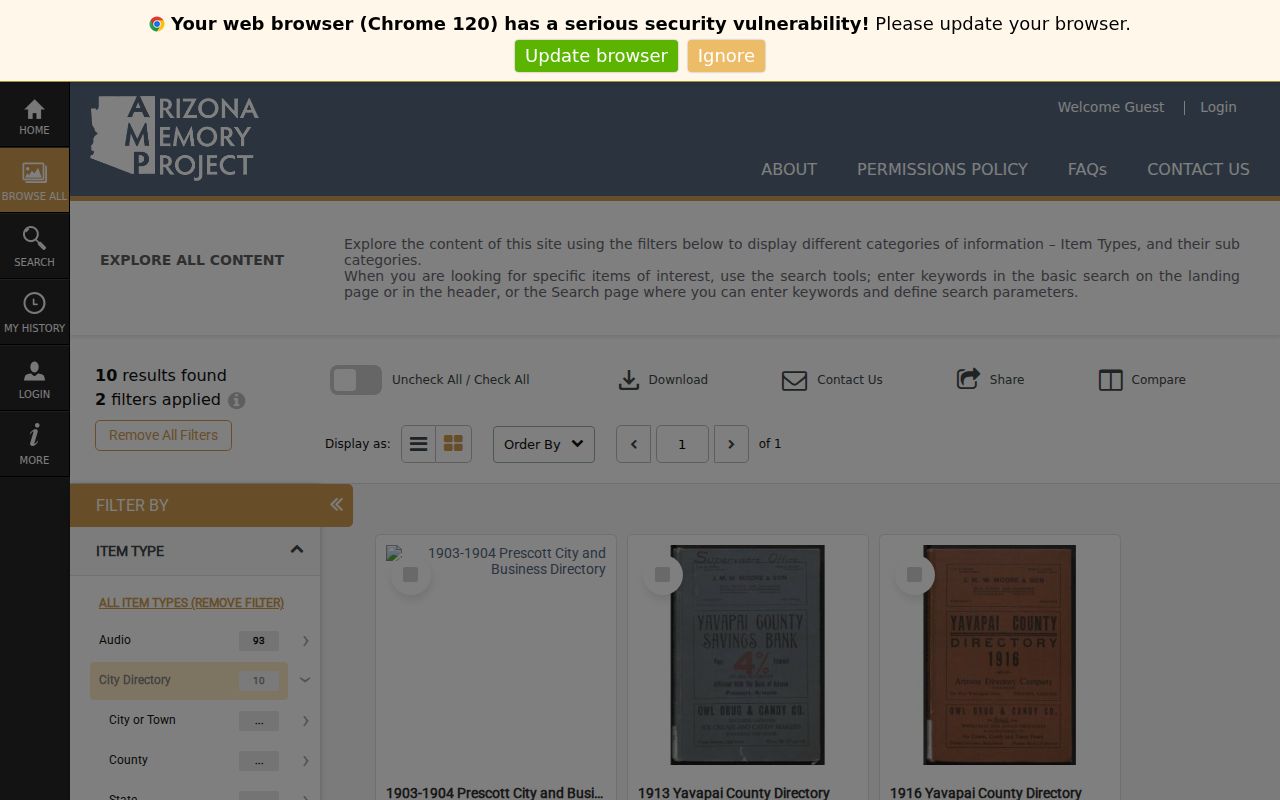
The captured collection view shows where the discrete directory editions can be opened. Search the chosen PDF for surname variants, then inspect its contents and locality headings before relying on a match.
Note: The digital collection is a set of dated snapshots, so an absent name in one edition does not prove absence from Yavapai County.
Read Prescott Valley Directory Entries
The 1916 book and the 1963 Luskey's volume organize evidence in opposite ways. The Arizona Directory Company arranged the 1916 edition around alphabetical businesses and private citizens. Its appendices also list officials, courts, societies, schools, churches, and clubs. Those institutional pages can separate people who share a surname. Luskey's 1963 book is expressly address first. Street headings lead to house numbers, occupant initials and surnames, a telephone number, and an asterisk whose meaning must be checked in the book's own key.
| Street heading | Groups the 1963 entries under a named road. |
|---|---|
| House number | Places entries in numeric order along that street. |
| Occupant line | Shows initials and surname as printed for that address. |
| Telephone | Uses the period's HI 5-xxxx exchange style where listed. |
| Asterisk | A printed marker that should not be interpreted until the abbreviation key is checked. |
A name-first directory answers where a known person was listed. An address-first book answers who was printed at a known place. Neither format proves legal ownership. Both preserve how a publisher understood a household at one moment.
- Criss-cross directory
- A book sorted by address or telephone rather than only by surname.
- Householder index
- An address-based list of the person whom the publisher associated with a dwelling.
- Abbreviation key
- The volume's own guide to marks, shortened words, and symbols. Read it before decoding an entry.
Name-First and Address-First Records
The shift from the 1916 alphabetical book to the 1963 address-first volume changes the search question. Begin with a surname in the earlier Prescott Valley directory context, then switch to a road and house number in Luskey's. The 1916 title page identifies the Arizona Directory Company of Phoenix as compiler and publisher. It also states a six-dollar price and describes an array of county towns, businesses, private citizens, and civic bodies.
| Edition milestone | What changed |
|---|---|
| 1903-04 | Earliest edition in the digitized Prescott/Yavapai set |
| 1916 | Alphabetical Arizona Directory Company county volume with civic appendices |
| 1951-63 | Selected telephone and directory issues preserved at Sharlot Hall |
| 1963 | Luskey's address-first criss-cross edition |
| 1966 onward | Plats, deeds, and later local evidence become vital for the new subdivision landscape |
This comparison is a practical search tool. The same person can be found by name in one era and by address in another. Always record the edition title, date, page, and locality heading.
Sharlot Hall Directory Research
The Sharlot Hall Research Center is the deepest documented regional shelf. Its selected runs include April and October 1951, August 1952, 1953 issues, summer 1954, and issues from 1955 through January 1963. Coverage varies among Prescott and county communities. An appointment is required. The center is open Wednesday through Friday from noon to 4 p.m. and Saturday from 10 a.m. to 2 p.m. Admission for research is free.
Remote help is unusually clear. Phone or email requests receive 30 free staff minutes. A response typically takes two to three business weeks, then research costs $25 per hour. Scanned pages cost $2 each. Give a full name, likely community, month or year, and source type. Books do not circulate, and staff retrieve rare material.
The center's detailed residency-source guide shows how precisely a request can be framed.
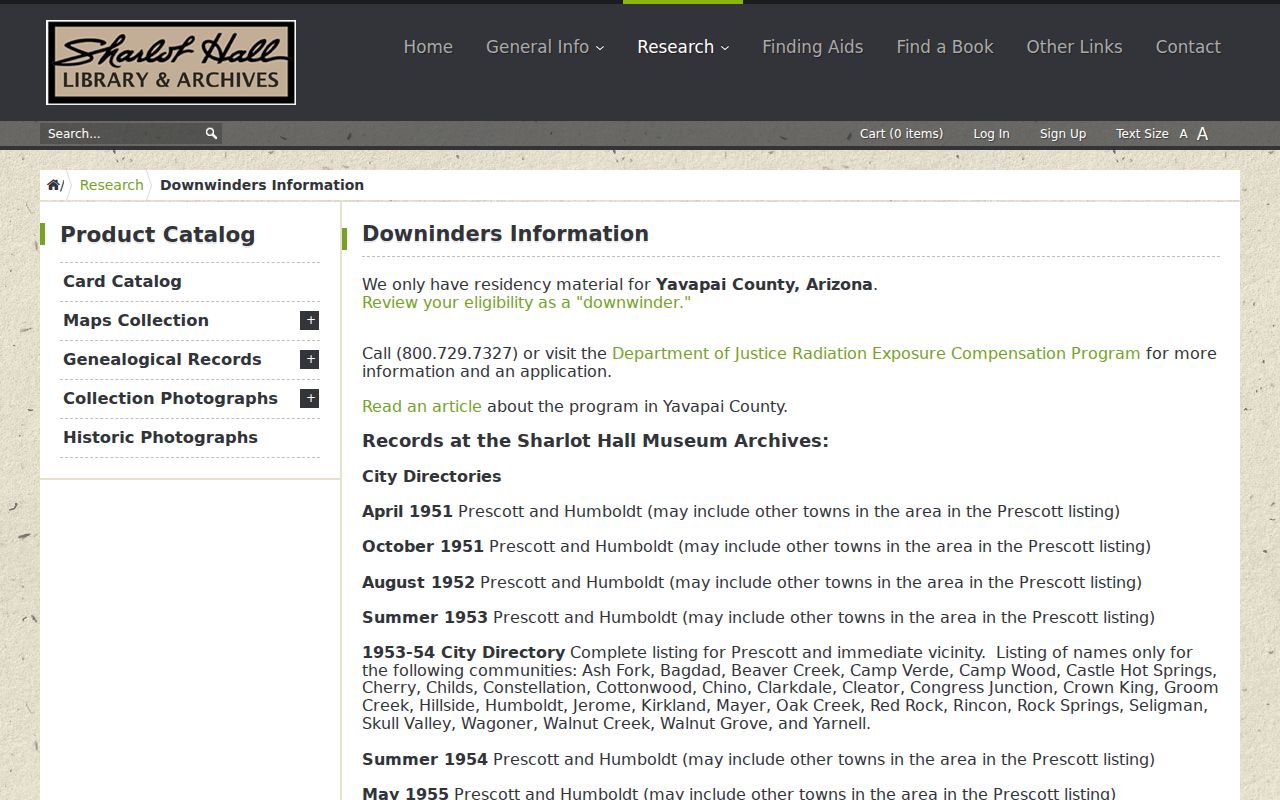
The source guide joins directories with school, parish, hospital, funeral, tax, court, and newspaper evidence. That breadth is useful when a city directory year is missing.
Before Prescott Valley Directories
Modern Prescott Valley grew from ranch land. The first subdivision unit dates to 1966. By 1972, twenty units held almost 12,000 lots across nearly 5.5 square miles, with more lots at Castle Canyon Mesa and Prescott East. The town incorporated in 1978. Those dates explain why classic city directories may not recognize the modern place name.
For an earlier trail, work backward from today's parcel number and legal description. A legal description is the formal land identifier recorded in a deed or plat. Follow the subdivision plat into Lonesome Valley and broader Yavapai geography, then check county directories, ranch material, newspapers, and the census. The public 1950 census predates both the first subdivision and incorporation. It can still name families in the region, but it cannot be searched as though today's town boundary already existed.
Note: A Prescott or county directory entry needs a coverage check before it is treated as evidence for land that later became Prescott Valley.
Prescott Valley Library Directory Gateways
The Prescott Valley Public Library provides local access to the Yavapai Library Network and its research tools. A card is free to Yavapai County residents who present two forms of identification, including a photo ID and proof of current address. The library's role is best understood as a gateway. Its item-level ownership of a historic city directory was not verified, so ask staff to check the network catalog rather than assume a volume is on the local shelf.
The library service screen offers the proper starting point for catalog and database access.

The captured page links the town library to the wider regional network. For deeper city directory holdings, continue to Prescott Public Library, Sharlot Hall, or the State of Arizona Research Library.
Prescott Valley Directory Companions
A directory rarely settles a family-history question alone. Yearbooks place a student in a school community. The Sharlot Hall obituary database and its index, begun in 2001 from mostly Prescott newspapers, can supply service, burial, occupation, and group affiliations. Funeral records, St. Luke's Episcopal parish files, county hospital material, precinct dockets, and the Prescott Courier add dated context. Each source has its own limits.
Prescott Public Library offers in-library genealogy tools, Arizona historical newspapers, Digital Arizona Library resources, and Digital Sanborn Maps. No Prescott Valley Sanborn sheet was verified. Since much of the town was built after the classic fire-map era, dated aerial imagery, plats, permits, and improvement data are safer substitutes than forcing a Prescott sheet onto the wrong parcel. Yavapai College's Boyd Tenney Library also preserves college life from 1966 through papers, minutes, oral histories, photographs, and publications.
Trace Prescott Valley Directory History
A sound household trail treats every city directory as a dated witness. Record what the book says, then test it against a second source. Start with the most certain name or address and move one edition at a time.
- Choose the edition that best matches the likely year and locality. Read its title and coverage notes first.
- Search surname variants in alphabetical books. In an address-first volume, browse the street and nearby house numbers.
- Copy the exact entry, page, marks, telephone, and source title. Photograph or save the abbreviation key as well.
- Compare the result with the 1950 census where the date and geography fit. Use yearbooks, papers, deeds, or tax records between census years.
- When the trail reaches post-1966 Prescott Valley, shift to plats and deeds for land continuity and use an obituary or probate file for a deceased person.
Disappearance from a book has several causes. A person may have moved, died, chosen an unlisted telephone, fallen outside the publisher's coverage, or been omitted. An address change is more persuasive when it also appears in a deed, school record, newspaper item, or later directory. For a modern address-based search, the Prescott Valley street directory keeps the current parcel and owner workflow separate from this historical shelf.